


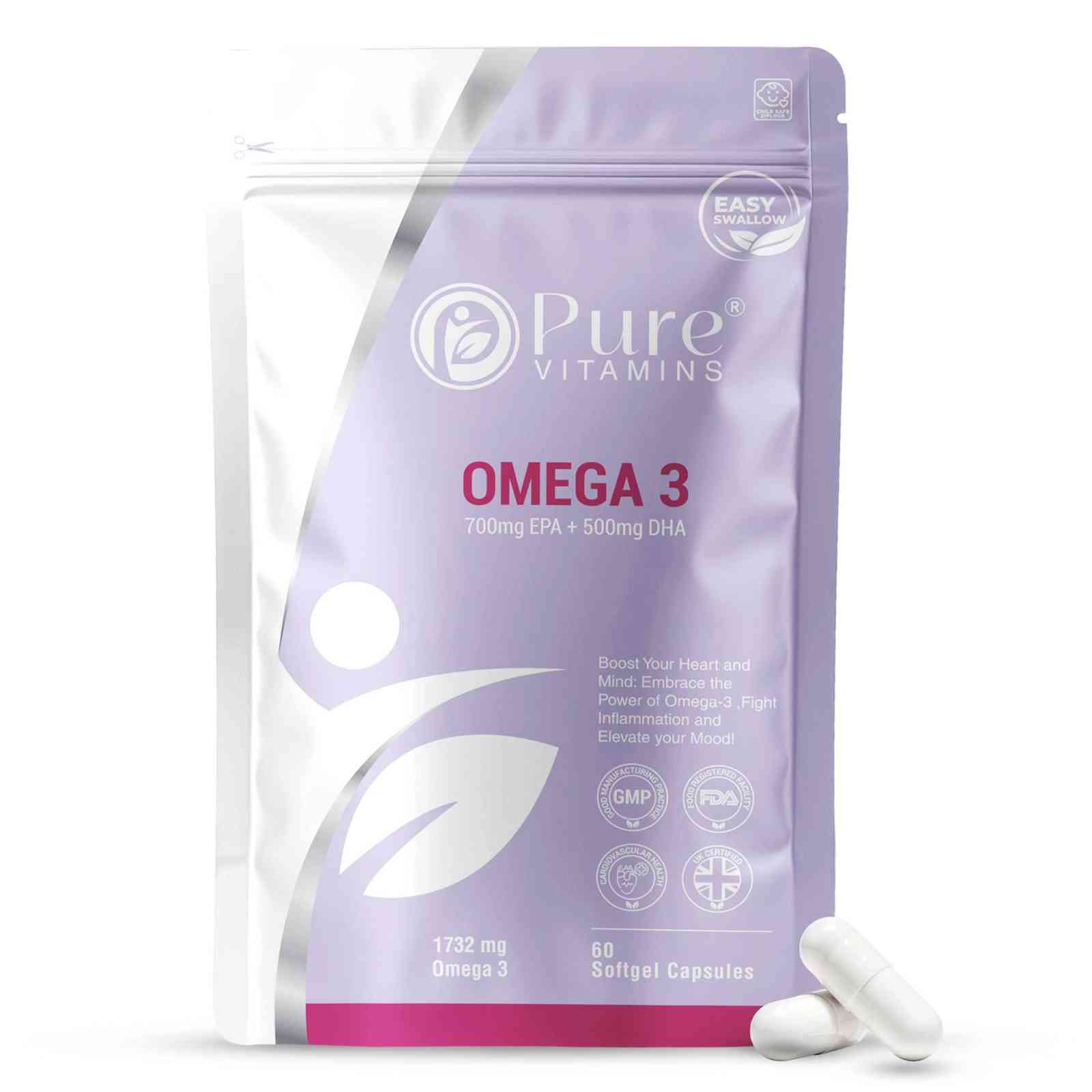
Omega-3 for heart and brain health is one of the few supplement topics where the roles are genuinely well established, yet the marketing around it is still full of overreach. So let me give you the grounded version: what EPA and DHA actually do, the doses that matter, what the research does and does not support, and how to choose a fish oil that delivers a real amount rather than a token one.
Reviewed and updated: 21 September 2026

Omega-3 for heart and brain health: the quick answer (TL;DR)
- Heart: EPA and DHA contribute to the normal function of the heart, at 250 mg of EPA plus DHA per day.
- Brain: DHA contributes to the maintenance of normal brain function, at 250 mg DHA per day. That is about maintaining function, not boosting memory.
- Vision: DHA contributes to the maintenance of normal vision, at 250 mg DHA per day.
- What matters when buying: the EPA and DHA numbers, not the total "fish oil" weight, and a dose that clears 250 mg comfortably.
EPA, DHA and ALA: the forms that matter
"Omega-3" is an umbrella term, but the two forms that do the heavy lifting for the heart and brain are EPA (eicosapentaenoic acid) and DHA (docosahexaenoic acid), both found in oily fish. A third, ALA (alpha-linolenic acid), comes from plants such as flaxseed but converts to EPA and DHA only poorly in the body. So when you choose a supplement for heart or brain support, it is the EPA and DHA content that counts, not the total fish oil weight, which can be misleading.
Omega-3 and the heart
EPA and DHA contribute to the normal function of the heart, with that effect coming at a daily intake of 250 mg of EPA and DHA combined. This is the most established and most common reason people take omega-3, and it is worth being precise: it is about supporting normal heart function, which is different from treating or preventing heart disease. The broader cardiovascular research exists but is genuinely mixed, so I keep the framing to what is solid: getting a proper daily amount of EPA and DHA. Our High-Strength Omega-3 Fish Oil delivers well above the 250 mg mark per serving. More on choosing in our piece on the best fish oil for heart health.
Omega-3 and the brain
DHA specifically contributes to the maintenance of normal brain function, again at a 250 mg daily intake of DHA. DHA is a major structural fat in the brain, concentrated in neuronal membranes, which is the genuine basis for that role. Honesty matters here: this is about maintaining normal brain function, not sharpening memory. A literature review found no scientific consensus that omega-3 reliably improves cognition in healthy adults, and a formal European evaluation of a separate "DHA improves memory" proposition concluded a cause-and-effect relationship had not been established. We explore this further in the FAQ below.

Omega-3 and vision
DHA also contributes to the maintenance of normal vision, at the same 250 mg daily intake. DHA is a structural fat in the retina, which is the basis for this lesser-known role and why omega-3 comes up in conversations about eye comfort. We cover the honest picture, including where the dry eye research is mixed, in the FAQ below.
How much omega-3 do you need?
The heart, brain and vision roles are all built on 250 mg per day, of EPA plus DHA for the heart and of DHA specifically for the brain and vision. A serious supplement clears that comfortably. Our omega-3 provides 1,040 mg EPA and 692 mg DHA per daily serving of two softgels. It is worth knowing the two fats are not identical in the body: based on a randomised controlled trial retrieved from PubMed, in 89 young healthy adults, DHA supplementation lowered blood triglycerides while EPA supplementation did not, pointing to genuinely different metabolic roles (Klingel et al., 2019, American Journal of Clinical Nutrition; DOI 10.1093/ajcn/nqz234, PubMed record). Two further omega-3 roles exist at much higher intakes (normal blood triglyceride levels at 2 g of EPA and DHA a day, and normal blood pressure at 3 g a day), which most everyday supplements do not reach. For a fuller breakdown of the forms and amounts, including what a real UK fish portion delivers and how to work out cost per 1,000 mg, see EPA vs DHA and how much you need.
Food sources and who tends to be low
The richest dietary sources of EPA and DHA are oily fish such as salmon, mackerel, sardines and anchovies. UK guidance suggests around two portions of fish a week, one of them oily, yet many people fall short. Those who eat little or no oily fish, including vegetarians and vegans, are the most likely to have a low intake, and an algal omega-3 is the plant-based route to EPA and DHA. See fish oil vs algae and when to take it.
How to take it
Take omega-3 with a meal that contains some fat, since it is fat-soluble and absorbs better that way. There is no special time of day required; daily consistency matters more than timing. A clean, fresh softgel with no rancid, fishy aftertaste is a good practical sign of quality.
Interactions and who should be cautious
- Blood thinners: if you take anticoagulants such as warfarin, or antiplatelet medicines, speak to your GP or pharmacist first, as omega-3 can affect bleeding tendency, particularly at high doses.
- High doses: very high omega-3 intakes have been linked in research to a higher chance of atrial fibrillation in some people, another reason not to mega-dose without advice.
- Before surgery: tell your clinical team about any omega-3 supplement ahead of planned procedures.
- Pregnancy and breastfeeding: omega-3 is widely used, but choose a product tested for purity and heavy metals and check with your midwife or GP.
- Fish allergy: this product contains fish (anchovies); an algal omega-3 is the alternative.
How to choose a fish oil that actually delivers
- Read the EPA and DHA, not the total oil: a 1,000 mg fish oil might contain only 300 mg of actual EPA and DHA.
- Clear 250 mg comfortably: that is the level the heart, brain and vision roles are built on; a serious dose exceeds it with room to spare.
- Purity and freshness: oil tested for heavy metals and not oxidised. Ours is tested for purity and heavy metals at a GMP-certified facility and is formulated in the UK.
- Favour numbers over drama: a good omega-3 lets its EPA and DHA figures do the talking rather than leaning on sweeping promises.

Where our fish oil sits
Our High-Strength Omega-3 Fish Oil is built around the numbers that matter, 1,040 mg EPA and 692 mg DHA per serving, comfortably clearing the 250 mg mark for the heart, brain and vision roles, in a clean softgel tested for purity and heavy metals. Everything we have written by nutrient sits together on the supplement guides hub, and you can browse the full range at the Pure Vitamins UK home page.

Signed, Dr. Miron, Founder of Pure Vitamins UK.
Frequently asked questions
Does omega-3 help with dry eyes?
Short version: omega-3 is not a treatment for dry eye disease, though DHA does contribute to the maintenance of normal vision at 250 mg a day. DHA is a structural fat in the retina, which is why the question comes up at all, but the research looking specifically at dry eye symptoms is genuinely mixed. Some trials have reported improvement, while one large, well-conducted trial found no benefit over placebo. If dry or gritty eyes are bothering you persistently, an optometrist or your GP is the right first stop rather than a supplement.
Does omega-3 help with brain fog?
Short version: no supplement clears brain fog, which is far more often driven by sleep, hydration, stress, or low iron or vitamin B12 than by anything to do with omega-3. DHA does contribute to the maintenance of normal brain function at 250 mg a day, and covering a genuine dietary shortfall is worthwhile in its own right. But if the fog is the main complaint, sorting out sleep and asking your GP for a blood test to check iron and B12 will tell you a great deal more than a fish oil will.
Findings are paraphrased from the published literature as science and are not product claims. Food supplements should not be used as a substitute for a varied, balanced diet and a healthy lifestyle. If you are pregnant, breastfeeding, taking medication or managing a medical condition, speak to your GP or pharmacist before starting a new supplement. Contains fish (anchovies).
