


Reviewed and updated: 24 July 2026
Turmeric needs black pepper because curcumin, turmeric's main compound, is poorly absorbed on its own, and piperine, the active compound in black pepper, markedly improves how much of it reaches the bloodstream. This is not a modern marketing trick: Indian kitchens have paired turmeric with black pepper and a little warm fat for centuries, in dishes and in golden milk, long before anyone measured why. It turns out tradition was onto something real. Here is the honest absorption story, what piperine is, the ratio that matters and why fat helps too. For more, see why turmeric and ginger are combined.
TL;DR: why black pepper is in turmeric
- The problem: curcumin is poorly absorbed and rapidly metabolised, so much of it is cleared before uptake.
- The fix: piperine from black pepper slows that metabolism, raising curcumin's bioavailability.
- The headline figure: a landmark human study reported roughly a 2000% increase in curcumin bioavailability with a small dose of piperine, though real-world numbers vary.
- Fat helps too: curcumin is fat-soluble, so taking it with a meal containing some fat aids absorption by a separate route.
- Caution: piperine can affect how some medicines are processed, so check with a pharmacist if you take prescriptions.

The problem black pepper solves
As we cover in turmeric vs curcumin, curcumin is poorly absorbed on its own. Taken in isolation it has low solubility and is rapidly converted in the gut and liver into curcumin glucuronide and sulfate, which is the major barrier to it reaching the circulation in both rodents and humans (Zeng et al., 2016, doi.org/10.1002/bdd.2049). Black pepper is the classic, time-tested answer to that problem. We cover the compounds more fully in what curcuminoids are.
What is piperine?
Piperine is the main active compound in black pepper and is what gives pepper its pungency. It is included alongside curcumin because it acts as a "bioenhancer": it reversibly inhibits the phase-II metabolising enzymes (UDP-glucuronosyltransferases and sulfotransferases) and efflux transporters that would otherwise clear curcumin quickly, so more of it survives to be absorbed (Zeng et al., 2016). It is the single most common absorption enhancer in turmeric products, which is why "turmeric and black pepper" is such a standard pairing. We explain it further in what is piperine.
The famous 2000% figure, in honest context
The number you will see quoted comes from a landmark human study by Shoba and colleagues, in which co-administering 20 mg of piperine with 2 g of curcumin increased curcumin bioavailability by approximately 2000% in healthy volunteers, achieved by inhibiting glucuronidation and efflux (Abd Halim et al., 2025, doi.org/10.1002/slct.202502516). That figure is genuine, but it is one study at one dose ratio; the real-world magnitude varies with dose, timing and formulation, so treat 2000% as an illustration of the principle rather than a guaranteed multiplier.

The turmeric-to-black-pepper ratio
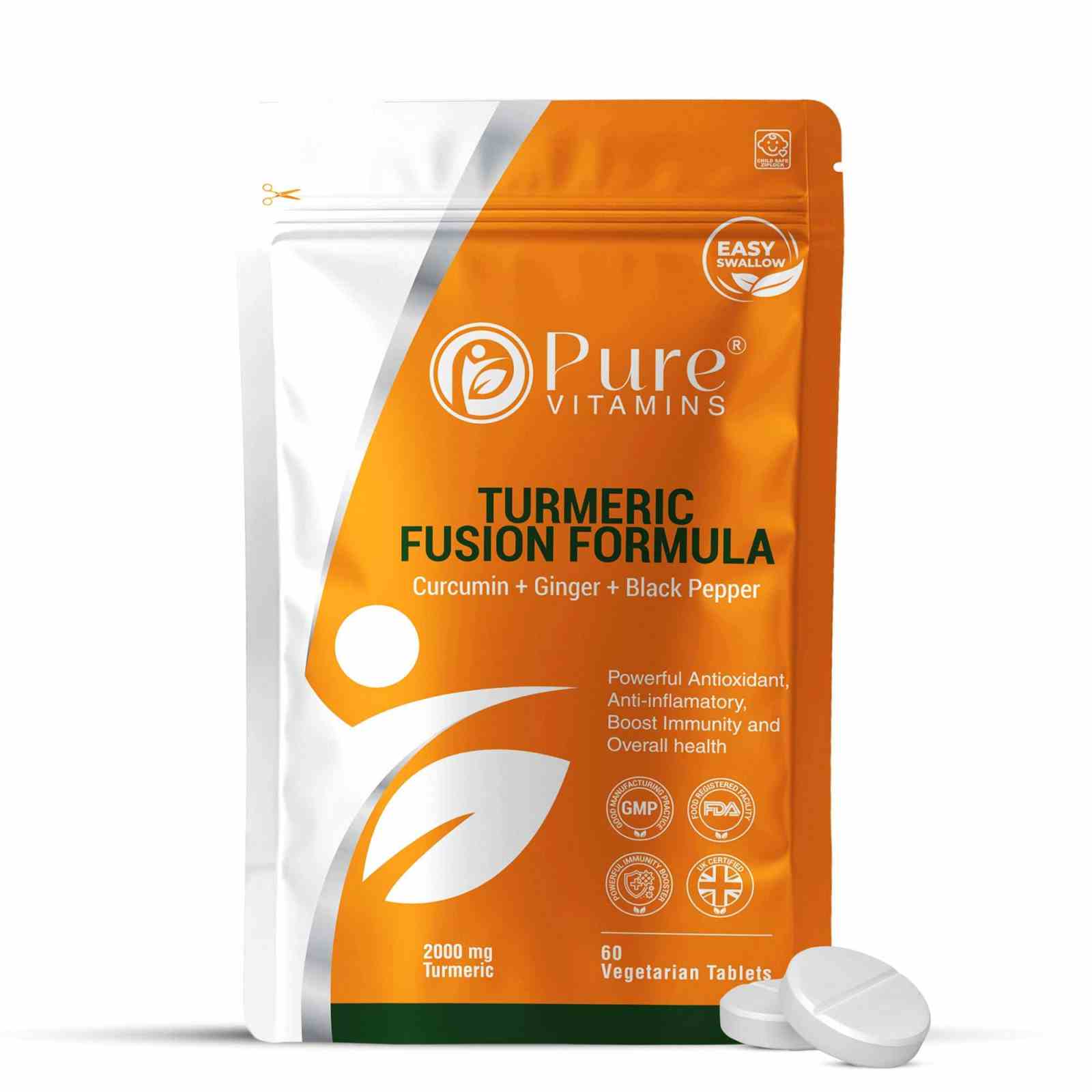
You only need a small amount of piperine relative to curcumin for the absorption support; black pepper is included in modest quantities, not equal measure. What matters more than an exact home-kitchen ratio is that a supplement includes a meaningful, standardised amount of piperine (often shown as a black pepper extract standardised for piperine content). Our Turmeric with Ginger & Black Pepper includes black pepper for exactly this absorption reason.
Why fat helps too
There is a second absorption factor worth knowing: curcumin is fat-soluble, so it is better absorbed in the presence of dietary fat. This is why taking turmeric with a meal that contains some fat is sensible, and why golden milk traditionally uses warm milk. The piperine and the fat support absorption through different routes. We cover the practical side in how to take turmeric.
Why ginger is in the mix
Our formula also includes ginger, a warming culinary botanical that has been paired with turmeric in South Asian cooking for generations. The two are botanical cousins and a familiar, time-honoured kitchen duo, so ginger rounds out a combination people instinctively recognise.
A few cautions worth knowing
Here is the important safety nuance. Because piperine can inhibit drug-metabolising enzymes in laboratory studies, there is a theoretical concern that it could raise the levels of some medicines. Reassuringly, a randomised study in healthy volunteers found that short-term use of a curcumin-and-piperine preparation did not meaningfully change the handling of several probe drugs, suggesting a clinically significant interaction is unlikely from normal short-term use (Volak et al., 2012, doi.org/10.1111/j.1365-2125.2012.04364.x). Even so, if you take prescription medication, particularly anything with a narrow therapeutic range, check with your GP or pharmacist first. Turmeric is best avoided in higher supplemental doses if you have gallstones or a bile-duct obstruction, may add to the effect of blood-thinning medication, and is best kept to culinary amounts in pregnancy. See turmeric safety and interactions for detail.
Frequently asked questions
Why does turmeric need black pepper?
Because curcumin, turmeric's main compound, is poorly absorbed on its own. Piperine from black pepper slows curcumin's breakdown and clearance, so more of it reaches the bloodstream.
How much black pepper is needed?
Only a small amount of piperine relative to curcumin. A good supplement states a standardised piperine content rather than relying on a vague "with black pepper".
Does turmeric really absorb 2000% better with pepper?
A landmark human study reported roughly that figure at a specific dose, but real-world results vary with dose, timing and formulation. Treat it as the principle, not a fixed multiplier.
Should I take turmeric with food?
Yes, taking it with a meal containing some fat is sensible, because curcumin is fat-soluble and absorbs better alongside dietary fat.
Explore the full range any time at Pure Vitamins UK.
Food supplements should not be used as a substitute for a varied, balanced diet and a healthy lifestyle. If you are pregnant, breastfeeding, taking medication or managing a medical condition, speak to your GP or pharmacist before starting a new supplement. Signed, Dr. Miron, Founder of Pure Vitamins UK.

