


Turmeric has been part of Ayurvedic kitchens and remedies in India for well over two thousand years, and if you want to know how to take turmeric well today, it really comes down to a few simple habits: take it with a meal that has a little fat in it, ideally with black pepper built in, at whatever time of day you will actually remember, and choose a standardised extract rather than leaning on the powder from your spice rack. That is the short version. Below I will walk you through the why behind each of those, plus dose, timing, how much is genuinely safe day after day, the 35:1 number you see on labels, shots versus tablets, and the handful of people who should take care.
Reviewed and updated: 21 September 2026
How to take turmeric: the quick answer (TL;DR)
- What it is: a golden root (Curcuma longa) traditionally used across India and South East Asia in cooking and wellness rituals, valued for its curcuminoids.
- Who it is for: anyone who wants a consistent daily amount of turmeric in a form the body can actually absorb.
- The one thing to know: curcumin is fat-soluble and poorly absorbed on its own, so how you take it matters as much as how much.
- How much is sensible: the internationally used acceptable daily intake for curcumin is 3 mg per kilogram of body weight, which is about 210 mg of curcumin a day for a 70 kg adult. The arithmetic is below, and it surprises people.
- My best tip: take it with your main meal of the day, with a standardised tablet that already includes black pepper, and keep to it daily.

With food or on an empty stomach?
With food is my sensible default, for two reasons. First, curcumin has very low water solubility and dissolves far better alongside dietary fat, so a meal that contains a little fat gives it a better run at being absorbed. Second, it is simply kinder on the stomach; some people find concentrated turmeric on an empty stomach a bit uncomfortable. A normal meal with some fat in it, think olive oil, eggs, oily fish, yoghurt, is the practical sweet spot.
Why fat and black pepper help
On its own, curcumin is famously hard to absorb because of its poor solubility, rapid metabolism and quick clearance from the body, which is exactly why the form you choose matters. Based on a study in healthy volunteers retrieved from PubMed, plain curcumin powder produced very low blood levels, while a micronised powder was roughly nine times higher and a liquid micellar formulation up to around 185 times more bioavailable (Schiborr et al., 2014, Molecular Nutrition and Food Research; DOI 10.1002/mnfr.201300724, PubMed record).
Black pepper is the traditional pairing, and the reason is piperine, the pungent alkaloid that gives pepper its bite. The proposed mechanism is not that piperine helps curcumin dissolve, but that it slows the rate at which the liver and gut wall conjugate and clear it, so more of what you swallow stays in circulation for longer. It is a genuinely old pairing, long predating anyone measuring it, which is why turmeric and pepper sit together in so many traditional dishes. Cooking turmeric in oil or ghee with a grind of pepper is essentially the original delivery system, and a well-made tablet is simply that idea, standardised.
An honest note on absorption
I would rather be straight with you than repeat marketing. The science here is more nuanced than "just add pepper". Based on a randomised crossover trial in healthy adults retrieved from PubMed, comparing formulations directly, solubility-based approaches, particularly micellar and cyclodextrin forms, raised curcumin levels the most, whereas the classic strategy of using adjuvants to slow curcumin breakdown did not improve absorption in that particular study (Flory et al., 2021, Molecular Nutrition and Food Research; DOI 10.1002/mnfr.202100613, PubMed record).
So black pepper is the long-standing, widely used pairing with a plausible mechanism behind it, but absorption depends heavily on the form of the product, and no single trick guarantees a result. That is the genuine state of the research, and anyone telling you otherwise is selling rather than explaining. If you are weighing up those delivery formats against each other before you buy, I have set them out side by side in my guide to the best form of curcumin to take.

The best time of day to take turmeric
There is no single correct time, because turmeric is not a stimulant and does not affect sleep, so timing is really about consistency and comfort. Many people take it with their largest meal, often lunch or dinner, precisely because that is when fat is present to help absorption. Because curcumin blood levels do not stay elevated indefinitely, some people split the day and take a dose with each main meal to keep levels topped up. Honestly, the best time is the one you will keep to every single day.
How much turmeric per day is safe?
This is the question underneath most of the others, and almost nobody converts it into a figure you can actually use, so let me do that.
There is an established reference point. International food safety assessment set an acceptable daily intake for curcumin of 0 to 3 mg per kilogram of body weight per day, and European assessment has reaffirmed the same figure. An acceptable daily intake is the amount considered safe to consume every day across a lifetime, with a large safety margin built in.
Worked through for real people, that is:
- 60 kg adult: about 180 mg of curcumin a day.
- 70 kg adult: about 210 mg a day.
- 80 kg adult: about 240 mg a day.
- 90 kg adult: about 270 mg a day.
Now put that against what you are actually swallowing, which is where it gets interesting.
Culinary turmeric is nowhere near it. Kitchen turmeric powder is only about 2 to 5 per cent curcuminoids. A heaped teaspoon is roughly 3 g, so it delivers somewhere around 60 to 150 mg of curcuminoids. Cook with turmeric daily and you are comfortably inside the acceptable daily intake. This is worth saying plainly, because people worry about the curry and not about the capsule.
A concentrated extract can pass it easily. A standardised extract is typically 95 per cent curcuminoids, so a 500 mg dose of that extract delivers around 475 mg of curcuminoids. For a 70 kg adult that is more than double the acceptable daily intake in a single tablet. Plenty of products on the market are sold at exactly that strength.
I want to be careful about what that does and does not mean. Exceeding an acceptable daily intake is not the same as taking a harmful dose; the figure is deliberately conservative and is about habitual lifetime intake, not a threshold where something goes wrong. Much of the clinical research on curcumin has deliberately used far higher amounts for short periods. But if you want a defensible answer to "how much is safe to take every day, indefinitely", the acceptable daily intake is the number to work from, and it is considerably lower than the marketing implies.
So here is how I would use it. Find the standardised curcuminoid content per serving on your label, not the total extract weight. Multiply your body weight in kilograms by 3 to get your own figure. If your product sits above it and you intend to take it indefinitely, that is worth a conversation with your GP or pharmacist, particularly if you take other medicines. Run that sum on any turmeric product, including ours.
What does a 35:1 turmeric extract mean?
An extract ratio like 35:1 means 35 parts of raw turmeric were concentrated down into 1 part of extract, giving you a form far richer in curcuminoids than plain kitchen turmeric. A higher first number means a more concentrated extract.
The ratio on its own is not the whole story, though, and this is where UK labels get confusing. Three numbers matter, and a good label gives you all three:
- The extract ratio, such as 35:1, telling you how concentrated it is.
- The standardised curcuminoid percentage, such as 95 per cent, telling you how much of the extract is the compound you are actually after. Without this figure, the ratio alone tells you very little.
- The piperine or black pepper amount, which is usually small, in the range of a few milligrams, and should still be stated rather than implied.
If a label gives you a big milligram number and none of the above, treat that number with suspicion, because it may well be the raw-equivalent weight rather than what is in the tablet. For the compound basics, see turmeric vs curcumin, and for why we pair it with ginger, why turmeric and ginger are combined.
Turmeric shots versus tablets
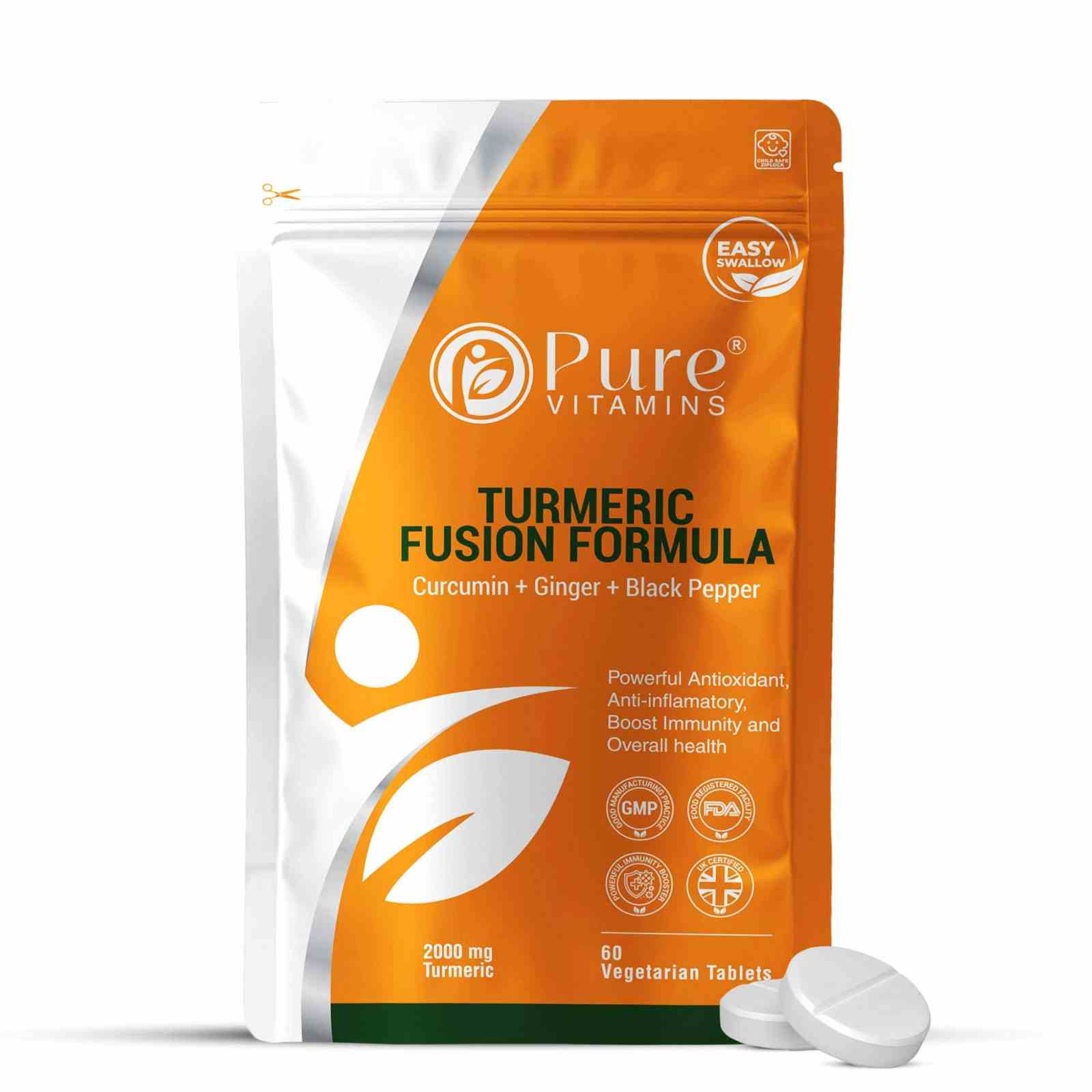
Both are just delivery formats. Shots, meaning liquid turmeric drinks, make a pleasant morning ritual but vary widely in actual curcuminoid content and often carry added sugar. Many contain far less than people assume, and almost none state a standardised curcuminoid figure, which makes the sum in the section above impossible to do. A tablet or capsule with a standardised extract gives you a consistent, measured amount with black pepper built in, which for a daily supplement is usually the more reliable and cost-effective route. Our Turmeric with Ginger and Black Pepper tablets are a standardised tablet made for exactly this, formulated in the UK and tested for purity and heavy metals at our GMP-certified facility.

How much turmeric do people actually take?
Culinary turmeric powder is only about 2 to 5 per cent curcuminoids, so the pinch you cook with is small in curcuminoid terms, as the arithmetic above shows. Supplements use standardised extracts instead, to deliver a consistent, concentrated amount in a single tablet, which is why a measured extract is more practical than spoonfuls of kitchen powder.
Research studies have generally used amounts well above everyday supplement levels and for defined periods rather than indefinitely, which is a distinction worth holding on to: a dose used for eight weeks under supervision in a trial is not automatically a sensible dose to take every day for years. Follow the dose on the label, weigh it against your own acceptable daily intake figure, and remember that more is not automatically better given how quickly the body absorbs and clears curcumin.
Common mistakes when taking turmeric
- Taking it without black pepper or fat, and missing the traditional absorption support.
- Relying on culinary powder for a supplement-level amount, when raw powder is only 2 to 5 per cent curcuminoids.
- Reading the extract weight as the curcuminoid amount, which are two very different numbers.
- Taking concentrated turmeric on an empty stomach, which some people find uncomfortable.
- Stacking several turmeric products at once, a blend, a shot and a tablet, without adding up the total.
- On-and-off use, when steady daily use is the whole point of a supplement.
- Ignoring interactions, which I cover next.
A few cautions worth knowing
Turmeric taken in normal supplement amounts is generally well tolerated, but a few groups should take a little care:
- Blood-thinning medication: turmeric may interact with anticoagulants such as warfarin, so check with your GP or pharmacist first.
- Gallstones or a blocked bile duct: concentrated turmeric is best avoided, because it stimulates bile flow.
- Surgery planned: it is sensible to stop turmeric supplements beforehand and tell your surgeon.
- Pregnancy and breastfeeding: keep to culinary amounts unless your midwife or doctor advises otherwise.
- With an iron supplement: as a polyphenol-rich spice, large amounts can blunt iron absorption, so space the two apart.
- Existing liver problems: rare cases of liver reactions have been reported with concentrated turmeric supplements, so speak to your GP first if your liver is already being monitored.
- Digestive upset: the most common complaint at higher intakes is simply stomach discomfort, nausea or loose stools, which usually settles on a lower dose taken with food.
My full turmeric safety guide goes into more detail.

Frequently asked questions
How much turmeric per day is safe?
The established acceptable daily intake for curcumin is 3 mg per kilogram of body weight per day, which is about 180 mg for a 60 kg adult, 210 mg for a 70 kg adult and 240 mg for an 80 kg adult. Culinary turmeric sits well inside that, since a heaped teaspoon delivers roughly 60 to 150 mg of curcuminoids. A 500 mg dose of a 95 per cent standardised extract delivers around 475 mg, which is above the figure for most adults. Exceeding it is not the same as a harmful dose, since the limit is deliberately conservative and about lifetime daily intake, but it is the right number to work from if you intend to take it indefinitely.
What is the best time of day to take turmeric?
There is no single best time. Turmeric is not a stimulant and does not affect sleep, so take it whenever you will remember it consistently, ideally with your main meal so there is some fat present for absorption.
Should I take turmeric with food?
Yes, with food is the sensible default. Curcumin is fat-soluble, so a meal with a little fat helps absorption, and food is also gentler on the stomach than a concentrated dose taken on an empty stomach.
Does turmeric really need black pepper?
Black pepper, and specifically the piperine in it, is the traditional and most common absorption pairing, and a good tablet builds it in. The proposed mechanism is that piperine slows how quickly the body clears curcumin rather than helping it dissolve. That said, research shows the form of the product matters at least as much, so pepper is a helpful pairing rather than a magic switch.
How do I read a turmeric label properly?
Look for three numbers: the extract ratio such as 35:1, the standardised curcuminoid percentage such as 95 per cent, and the piperine or black pepper amount. The standardised percentage is the one that tells you how much of the compound you are actually getting, and without it the ratio alone means little. Be wary of a large milligram figure with none of the three, as it may be a raw-equivalent weight rather than what is in the tablet.
Who should not take turmeric supplements?
Take care if you are on blood-thinning medication, have gallstones or a bile duct problem, have surgery planned, have an existing liver condition, or are pregnant or breastfeeding. Check with your GP or pharmacist if any of these apply to you.
The takeaway
Take turmeric with a meal that has some fat, at whatever time you will keep to; choose a standardised extract, where a ratio like 35:1 signals concentration and the curcuminoid percentage tells you what is really in it, with black pepper built in; work out your own acceptable daily intake as body weight in kilograms times three; and steer clear of the common mistakes above. The absorption science is real but nuanced, so judge a product on its form, its stated numbers and your own consistency rather than any single trick. For the bigger picture, see turmeric and joints. Everything we have written by nutrient sits together on the supplement guides hub, and you can browse the full range at Pure Vitamins UK.
Research findings are paraphrased from the published literature as science and are not product claims. Food supplements should not be used as a substitute for a varied, balanced diet and a healthy lifestyle. If you are pregnant, breastfeeding, taking medication or managing a medical condition, speak to your GP or pharmacist before starting a new supplement. Signed, Dr. Miron, Founder of Pure Vitamins UK.
