


Reviewed and updated: 22 September 2026
Turmeric vs curcumin: what's the difference?
The turmeric vs curcumin question is simple once you see the relationship: turmeric is the whole golden root, and the culinary spice ground from it, while curcumin is the main active compound found inside turmeric, making up only a few per cent of the root by weight. So curcumin is a part of turmeric, not a separate plant. That is the short answer. Below I will show you the arithmetic almost nobody works through, which is how many milligrams of curcuminoids you actually get from a spoonful of turmeric powder compared with a standardised extract, and how to read a label so you can tell in the shop which of the two you are holding.

Quick answer (TL;DR)
- Turmeric is the whole root and spice, containing curcuminoids plus volatile oils, fibre, starch and other plant compounds.
- Curcumin is the principal curcuminoid inside turmeric, typically only about 2 to 5 per cent of the dried root, and commonly around 3 per cent.
- The practical gap: a level teaspoon of cooking turmeric delivers roughly 90 mg of curcuminoids. A single 500 mg extract standardised to 95 per cent delivers around 475 mg, which is about five teaspoons' worth.
- Why it matters: curcumin is poorly absorbed on its own, so standardised extracts and piperine from black pepper are used to improve uptake.
- Label trap: a big "turmeric 7,000 mg" number on the front is usually raw-root equivalent from a much smaller amount of extract.
A golden spice with a long history
Turmeric, Curcuma longa, is a rhizome that has been prized for centuries, both as the warm, earthy spice at the heart of South Asian cooking and as a cornerstone of traditional Ayurvedic practice, where the bright root has long been valued and reached for as part of daily life. That heritage is a big part of why so many people are curious about it today, and why it helps to know exactly what you are buying.
Turmeric is the root; curcumin is the active compound
The yellow colour of turmeric comes from its curcuminoids, a small family of related compounds of which curcumin is the most abundant and most studied. The other two you will see named are demethoxycurcumin and bisdemethoxycurcumin, and together the three are what a label means by "total curcuminoids".
Crucially, ground turmeric powder contains only a small fraction of them. Dried turmeric root is commonly cited at about 2 to 5 per cent curcuminoids, with around 3 per cent a fair working average for ordinary culinary turmeric. Everything else in that spoonful, the other 95 per cent or more, is starch, fibre, protein, minerals and the volatile oils that give turmeric its aroma. So when people say "curcumin", they almost always mean a concentrated extract standardised to a far higher curcuminoid content than the raw spice.
The arithmetic: how much curcumin is actually in a spoonful?
This is the comparison that makes the whole question concrete, and it is worth doing once so you never have to wonder again.
- One level teaspoon of ground turmeric weighs roughly 3 grams, which is 3,000 mg. At around 3 per cent curcuminoids, that is about 90 mg of curcuminoids. At the low end of the range, 2 per cent, it is 60 mg; at the top of the range, 5 per cent, it is 150 mg. Real spice jars vary, and older powder that has sat open for a year will be at the weaker end.
- One 500 mg extract standardised to 95 per cent curcuminoids delivers about 475 mg of curcuminoids from a single tablet. That is roughly five teaspoons of ordinary turmeric powder, condensed.
- A 35:1 standardised extract, like the one we use, means one part extract is concentrated from thirty-five parts raw root. So a 200 mg dose of a 35:1 extract represents around 7,000 mg, or 7 grams, of raw-root equivalent, which is more than two teaspoons of spice in a tablet you can swallow.
Now apply that in a shop. If one product says "turmeric 7,000 mg" and another says "turmeric extract 200 mg (35:1)", those can be the very same thing described two ways. And if a third says "turmeric root powder 1,000 mg" with no extract ratio and no curcuminoid percentage, it is genuinely 1,000 mg of spice, which at 3 per cent is about 30 mg of curcuminoids, roughly a third of a teaspoon. Three products, three very different amounts of the compound you are actually buying.
If you want to turn that into a daily safety figure rather than a comparison, the acceptable daily intake arithmetic is worked through properly in the pillar guide, how to take turmeric.
What "standardised extract" means on a label, and the three numbers to find
A standardised turmeric extract concentrates the curcuminoids to a defined level, so you know how much active compound you are getting rather than trusting the harvest. When you pick up a pack, look for three numbers:
- The extract ratio (for example 35:1), which tells you the degree of concentration from raw root.
- The standardised curcuminoid percentage (commonly 95 per cent for an isolate), which tells you how much of the extract is actually curcuminoids.
- The piperine or black pepper amount, usually a small figure in single-digit milligrams, which tells you whether absorption has been addressed at all.
If a label gives you none of those and only a large front-of-pack milligram figure, that is the product making the comparison difficult on purpose. Our Turmeric with Ginger and Black Pepper uses a 35:1 standardised turmeric extract alongside ginger extract and black pepper, and states each component.

Whole-root turmeric or an isolated extract: what else the root carries
There is a genuine argument on both sides here, and it is not simply that more concentrated is better.
An isolated 95 per cent curcuminoid extract gives you the most studied compounds at the highest concentration and the most predictable dose. That is its whole appeal. What it leaves behind is everything else in the root, including turmerone and the other volatile oils, which are part of what the traditional preparation always contained and which some whole-root and full-spectrum products deliberately retain.
A whole-root or lower-ratio extract keeps more of that natural matrix but delivers fewer curcuminoids per tablet. Neither approach is wrong. What matters is that you know which one you are buying, and that you are not paying isolate prices for spice, or expecting isolate-level curcuminoid amounts from a whole-root capsule. If you want the formats compared properly, from piperine pairing to phytosome and micellar preparations, that is my guide to the best form of curcumin to take.
Why black pepper (piperine) is added
Curcumin is notoriously hard for the body to absorb, because it is poorly soluble in water and is processed and cleared quickly once it does get through. Piperine, the active compound in black pepper, is the classic answer to that. In the best-known human study, retrieved from PubMed, adding just 20 mg of piperine to a 2 g dose of curcumin raised its measured bioavailability substantially in healthy volunteers, with no adverse effects at the doses used (Shoba and colleagues, 1998, Planta Medica, DOI 10.1055/s-2006-957450, read it on PubMed). More recent work echoes the theme, with black pepper extending curcumin's half-life and increasing 24-hour recovery compared with curcumin alone (Khajehpour and colleagues, 2023, Food Science and Nutrition, DOI 10.1002/fsn3.3691, read it on PMC).
That absorption science is exactly why well-formulated turmeric supplements pair the extract with piperine, and it is reported here as science about the compounds rather than a promise about any product. The practical version, including the fat question and timing, is in the pillar guide, how to take turmeric.
Culinary turmeric versus a supplement: which do you actually want?
Both are legitimate, they are simply different things.
- Cooking with turmeric gives you modest curcuminoid amounts alongside the rest of the root, usually in a dish that already contains fat and often black pepper, which is a rather elegant traditional solution to the absorption problem. It is food, and it is a pleasure.
- A standardised supplement gives you a known, much larger and better-absorbed curcuminoid dose in a single tablet, which is what you want if the concentrated compounds are the point.
Trying to reach supplement-level curcuminoid amounts through the spice jar means eating several teaspoons of turmeric a day, which most people find unpleasant and which brings a good deal of oxalate along with it. That is the honest reason supplements exist here.

Where ginger fits in
Some formulas, including ours, also add ginger, another rhizome from the same botanical family with its own long culinary and traditional-use history. Including ginger and black pepper alongside turmeric makes a warm, whole-spice-style blend rather than a single curcumin isolate. Whether you prefer a blend or a high-percentage isolate is really a matter of preference, since both deliver curcuminoids. I explain the pairing in why turmeric and ginger are combined.
What the research keeps coming back to
If there is one honest theme across the curcumin science, it is absorption. Study after study returns to the fact that curcumin's natural bioavailability is low, which is precisely why formulation, standardisation and piperine matter so much. I share that as background about the compound rather than as a promise about any supplement, and much of the deeper clinical research is in specific populations rather than everyday healthy adults, so it is worth reading with a clear head.
It is also worth saying plainly that a bigger number on the front of a pack is not evidence of anything. The comparison that means something is curcuminoids delivered per day, at a stated percentage, with absorption addressed.
How to choose, and how much
When choosing between a "turmeric" and a "curcumin" product, a standardised extract with piperine gives you a known, better-absorbed curcuminoid dose, whereas raw turmeric powder is lovely as a food spice but provides far less. Follow the label directions, and take it with a meal containing some fat, since curcuminoids are fat-soluble. There is no single official daily curcumin figure for supplements in the UK, so stick to the product's stated serving, and do not stack two turmeric products without adding up what you are taking in total. The safe-upper-intake discussion sits in the pillar, how to take turmeric.
A few cautions worth knowing
Concentrated turmeric or curcumin extracts are best used with care around certain medicines. Curcumin may affect blood clotting, so speak to your doctor before combining it with warfarin or other anticoagulants. People with gallstones or a bile-duct obstruction are generally advised to avoid concentrated turmeric, as it can stimulate bile flow. Turmeric is also relatively high in oxalate, which is worth knowing if you have a history of kidney stones. If you are pregnant or breastfeeding, take medication, or manage a health condition, check with your GP or pharmacist before taking a high-strength extract. Culinary amounts in cooking are not a concern. The fuller safety picture is in turmeric safety and interactions, and the honest position on joints is in turmeric and joints.

Where Pure Vitamins fits
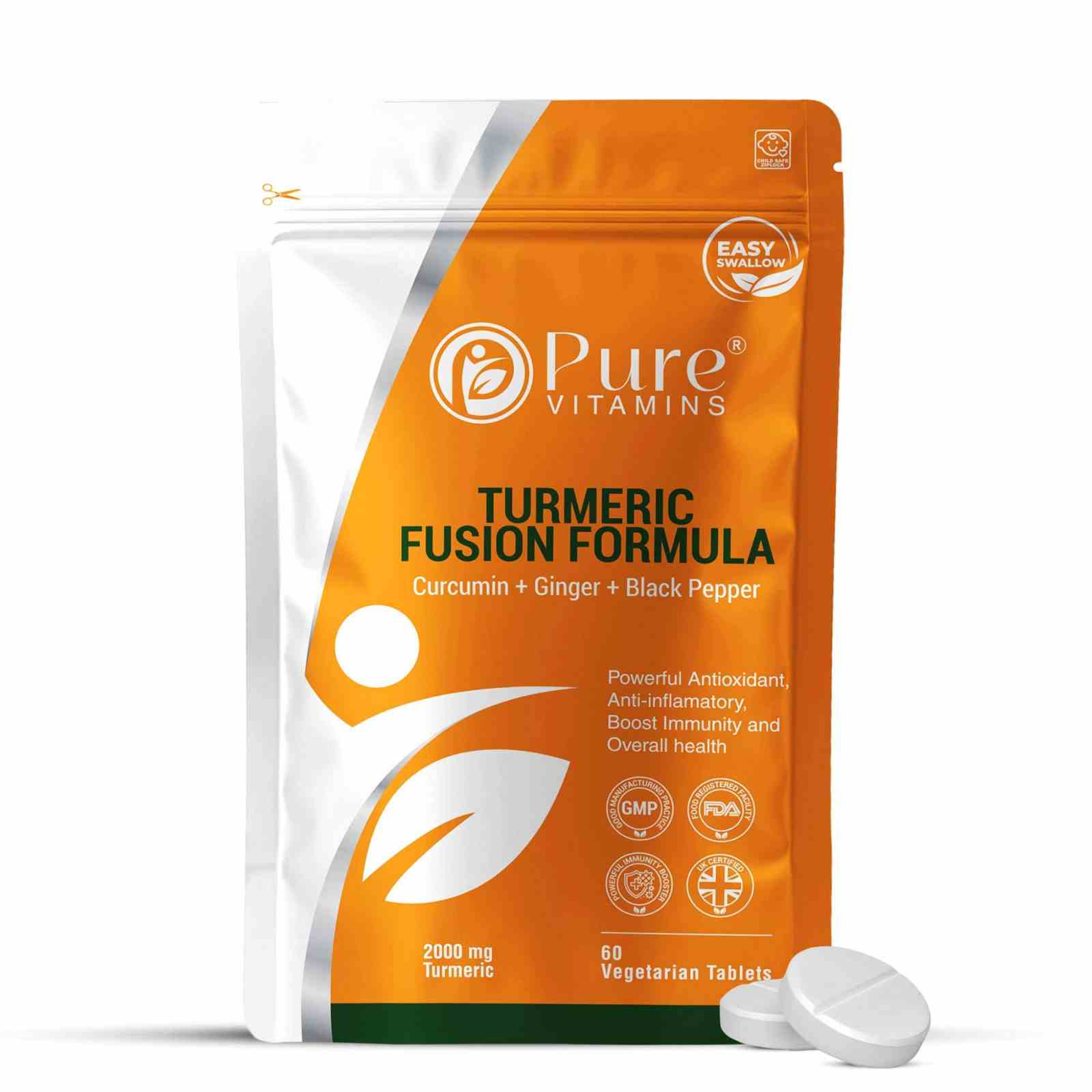
Our Turmeric with Ginger and Black Pepper combines a 35:1 standardised turmeric extract with ginger and piperine for better-absorbed curcuminoids, formulated in the UK and tested for purity and heavy metals at our GMP-certified facility. Every guide we publish sits on the supplement guides hub, or browse everything on our Pure Vitamins UK home page.
Shop Turmeric with Black Pepper
Frequently asked questions
Is curcumin the same as turmeric?
No. Curcumin is the main active curcuminoid inside turmeric, while turmeric is the whole root, of which curcuminoids are only about 2 to 5 per cent by weight.
Is turmeric with curcumin better than plain turmeric?
They are different products rather than better and worse. A standardised extract gives a far higher, known curcuminoid dose per tablet; plain turmeric root powder gives the whole root at a much lower curcuminoid amount. If concentrated curcuminoids are what you are after, the standardised extract with piperine is the one.
How much curcumin is in a teaspoon of turmeric?
A level teaspoon is roughly 3 grams of powder, and at around 3 per cent curcuminoids that is about 90 mg, with a realistic range of roughly 60 to 150 mg depending on the root and how fresh the powder is. A 500 mg extract at 95 per cent delivers around 475 mg, about five teaspoons' worth.
What does a 35:1 turmeric extract mean?
One part extract is concentrated from thirty-five parts raw root, so a 200 mg dose represents around 7,000 mg of raw-root equivalent. That is why a front-of-pack figure of 7,000 mg and an ingredients line reading 200 mg of 35:1 extract can describe the same tablet.
Is curcumin stronger than turmeric?
A standardised curcumin extract is far more concentrated in curcuminoids than raw turmeric spice, which is what people usually mean by stronger.
Why is black pepper in turmeric supplements?
Piperine markedly improves curcumin absorption, which is otherwise low. It is a small amount doing a specific job, and its absence is a reasonable thing to notice on a label.
Should I take it with food?
Yes, with a meal containing some fat, since curcuminoids are fat-soluble. This is also, conveniently, how turmeric has traditionally been eaten.
Food supplements should not be used as a substitute for a varied, balanced diet and a healthy lifestyle. If you take anticoagulants, have gallstones or a history of kidney stones, are pregnant or breastfeeding, or manage a medical condition, speak to your GP or pharmacist before taking a concentrated extract.
Signed, Dr. Miron, Founder of Pure Vitamins UK.
Related articles
- How to take turmeric: food, fat, timing and extracts
- What is the best form of curcumin to take?
- Why turmeric and ginger are combined
- Turmeric safety, medications and who should take care
- Turmeric and joints: the honest position
- Turmeric with Ginger and Black Pepper tablets
Sources
- Shoba G and colleagues (1998). Influence of piperine on the pharmacokinetics of curcumin in animals and human volunteers. Planta Medica. DOI 10.1055/s-2006-957450. PubMed 9619120
- Khajehpour S and colleagues (2023). Black pepper and curcumin pharmacokinetics. Food Science and Nutrition. DOI 10.1002/fsn3.3691. PMC10724617
