


Reviewed and updated: 10 August 2026
If you are weighing up whether ashwagandha KSM-66 is better than magnesium, the honest answer is that neither is universally better, because they are two very different things doing two different jobs. Magnesium is an essential mineral your body needs every day and cannot make, with a set of authorised UK health claims behind it. Ashwagandha KSM-66 is a standardised root extract of a traditional Ayurvedic plant, sold on its composition and heritage rather than on any approved health claim. Which one suits you depends entirely on your goal, and for many people the sensible answer is not one or the other but understanding what each actually does.
Is ashwagandha KSM-66 better than magnesium? The short answer
Ashwagandha KSM-66 and magnesium are not interchangeable, so "better" only makes sense once you decide what you want from a supplement. If you are topping up an essential mineral that supports your nervous system, muscles and energy metabolism, magnesium is the one with formal nutrient function claims behind it in the UK. If you are interested in a traditional adaptogenic botanical that has been studied for stress and sleep, ashwagandha KSM-66 is the more relevant choice, though as a herb it carries no authorised health claims and is sold on its standardised composition. They are different categories of product. This guide explains what each one is, what the evidence shows, the sensible doses and safe limits, who should be cautious, and how to choose between them, or combine them, based on your own goal.
TL;DR: ashwagandha KSM-66 vs magnesium
- What they are: Magnesium is an essential dietary mineral. Ashwagandha KSM-66 is a standardised extract of the root of Withania somnifera, a traditional adaptogenic herb.
- Claims status in the UK: Magnesium has authorised EU/GB nutrient function claims (nervous system, muscles, psychological function, tiredness and fatigue, and more). Ashwagandha has no authorised health claims, so it is sold on composition and traditional use only.
- Best matched to: Magnesium for broad daily mineral support and anyone whose intake may be low. Ashwagandha KSM-66 for those specifically interested in an adaptogen with a stress and sleep research history.
- Together? They are commonly taken together and there is no known reason they cannot be, though timing and individual tolerance matter.
- Key cautions: Magnesium can loosen the stool at higher doses and needs care in kidney disease. Ashwagandha is not recommended in pregnancy or breastfeeding and may not suit people with thyroid conditions or on certain medicines. Check with your GP or pharmacist first.

What ashwagandha KSM-66 actually is, and what the research has looked at
Ashwagandha (Withania somnifera, sometimes called Indian ginseng or winter cherry) is a small shrub used for centuries in Ayurveda, where it is classed as a Rasayana, or rejuvenating tonic, and described as an adaptogen. KSM-66 is a specific branded extract made only from the root of the plant, not the leaves, and standardised to a minimum of 5% withanolides, the group of naturally occurring compounds used as the marker for a quality ashwagandha extract. Standardisation matters because cheap, unstandardised root powders give no guarantee of how much active material is present. If you want the detail on extraction and grading, our explainer on what KSM-66 ashwagandha is and why withanolide standardisation matters goes deeper.
Here is the important compliance point, stated plainly. In the UK, botanicals like ashwagandha do not hold authorised health claims, so we cannot tell you that ashwagandha will reduce your stress, improve your sleep or do anything else to your body. What we can do is describe the plant honestly and paraphrase what the published research has reported, as science.
And the research is genuinely interesting. A 2022 systematic review and meta-analysis of 12 randomised controlled trials, pooling 1,002 participants, reported that ashwagandha supplementation was associated with reduced anxiety and stress scores compared with placebo, with the most studied effective stress doses sitting in the 300 to 600 mg per day range. Crucially, the authors rated the certainty of the evidence as low and called for higher-quality trials, so this is a promising signal rather than a settled fact (Akhgarjand et al., 2022, https://doi.org/10.1002/ptr.7598). A separate randomised, double-blind, placebo-controlled trial in 125 healthy but stressed adults found that 300 mg of a sustained-release ashwagandha root extract taken daily for 90 days was associated with lower perceived-stress scores, lower morning serum cortisol and better self-reported sleep quality than placebo, with no adverse events reported (Gopukumar et al., 2021, https://doi.org/10.1155/2021/8254344). Trials like these are why cortisol, the body's main stress hormone, comes up so often in ashwagandha discussions. The science is worth understanding, but it describes what happened in study participants. It is not a promise about what a supplement will do for you.
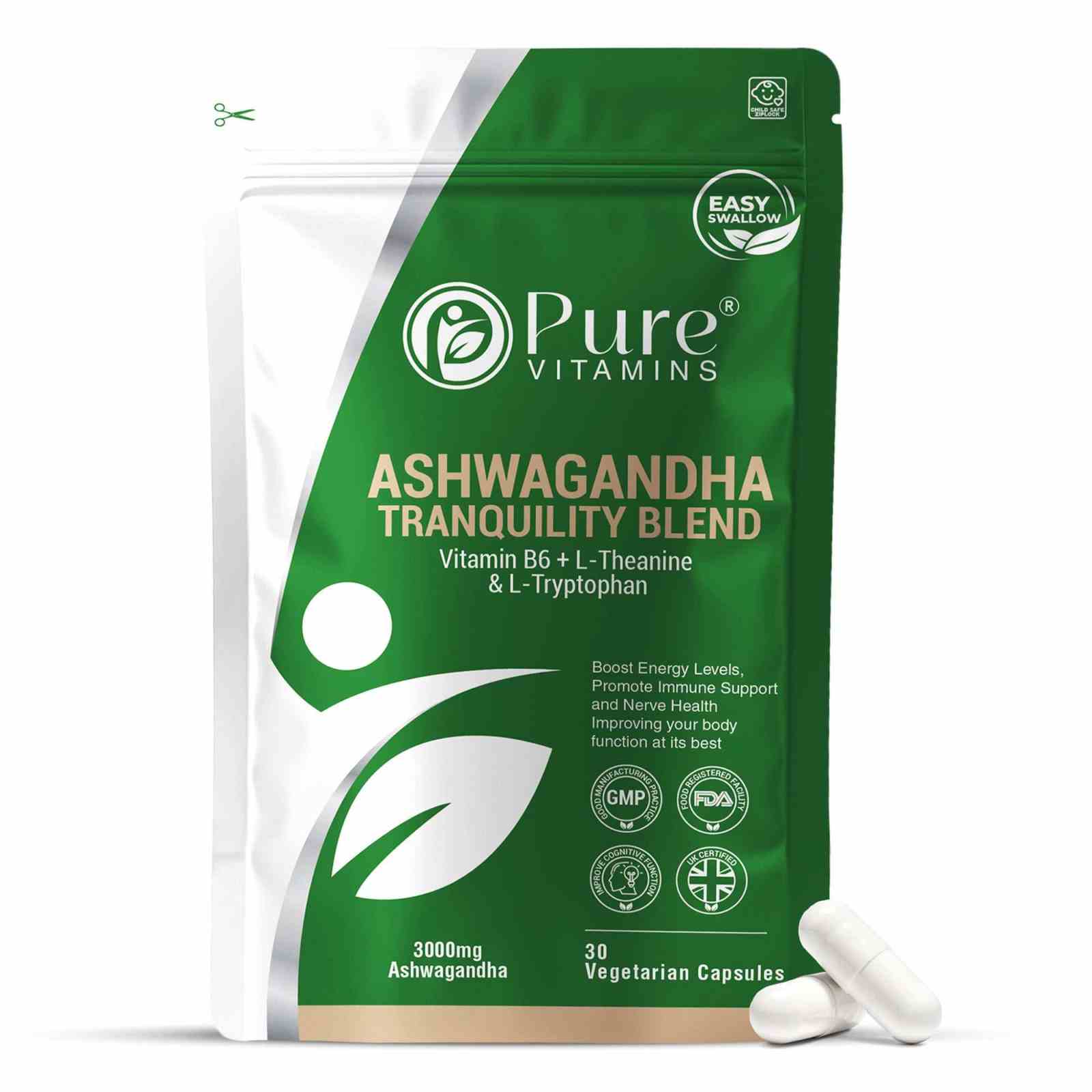
The Pure Vitamins ashwagandha supplement pairs KSM-66 with L-Theanine, an amino acid found in green tea, along with L-Tryptophan, black pepper extract and Vitamin B6. The botanical and the amino acids carry no authorised claims and are included on the basis of their composition. Vitamin B6 is different, because it is a vitamin with approved claims, and we return to that below.
What magnesium is good for, and why it has authorised claims
Magnesium is an essential mineral involved in hundreds of enzyme reactions, from energy production to nerve signalling and muscle contraction. Because it is a recognised nutrient, it carries a set of authorised EU and GB nutrient function claims that apply when a product provides a meaningful amount, defined as at least 15% of the Nutrient Reference Value (the magnesium NRV is 375 mg). Our magnesium glycinate 3-in-1 provides 384 mg of elemental magnesium per daily serving of two capsules, which is 102% of that NRV, so the authorised wording applies in full.
Within the exact authorised wording, magnesium contributes to:
- normal psychological function;
- the normal functioning of the nervous system;
- normal muscle function;
- the reduction of tiredness and fatigue;
- normal energy-yielding metabolism;
- electrolyte balance;
- normal protein synthesis;
- the maintenance of normal bones and teeth.
That list is the heart of why magnesium and ashwagandha are not really competitors. Magnesium is a foundational nutrient with a defined role in normal body function, and the claims above are statements the regulator permits. Ashwagandha is a botanical with a research story but no permitted claims. So a fairer question than "which is better" is "which job am I trying to do".
It is also worth knowing that the form of magnesium matters for comfort and absorption. Our magnesium glycinate 3-in-1 combines magnesium bisglycinate, which is well absorbed and gentle on the stomach, with magnesium malate and magnesium citrate. If you want the detail on forms, the difference between magnesium glycinate and citrate is covered in its own guide.

Ashwagandha vs magnesium for stress
Stress is the goal most people have in mind when they compare these two, so it deserves a careful, honest answer.
On the magnesium side, the framing is the cleanest, because magnesium contributes to normal psychological function and to the normal functioning of the nervous system as authorised claims. Beyond that authorised wording, the research is supportive but nuanced. A randomised controlled trial in stressed adults with low blood magnesium found that magnesium supplementation improved anxiety and depression scores over eight weeks, and that adding vitamin B6 appeared to augment the benefit, particularly in those who were most stressed (Noah et al., 2021, https://doi.org/10.1002/smi.3051). The key word there is "low": the clearest benefits in that study were in people who started with suboptimal magnesium status, which is exactly the deficiency-correction point we make later.
On the ashwagandha side, the research summarised above pointed to reductions in perceived stress and anxiety scores in trials, alongside lower cortisol in some studies (Akhgarjand et al., 2022, https://doi.org/10.1002/ptr.7598; Gopukumar et al., 2021, https://doi.org/10.1155/2021/8254344). But the certainty of the evidence was rated low, the trials were short, and we are not permitted to convert any of that into a claim about what ashwagandha will do for you.
So which is "better" for stress? If your interest is a recognised nutrient with authorised psychological-function and nervous-system claims, magnesium is the more straightforward pick, especially if your intake may be low. If you are specifically drawn to an adaptogenic botanical with a stress-research history and accept that it carries no health claim, ashwagandha KSM-66 is the option built around that. Many people interested in everyday calm choose magnesium for a busy mind as their foundation and consider ashwagandha as an addition rather than a replacement.
Ashwagandha vs magnesium for sleep
Sleep is where the compliance lines really matter, so read this section carefully.
There is no authorised UK health claim linking magnesium to sleep. That means we cannot say magnesium helps you sleep, even though it is one of the most popular evening supplements. What we can do is paraphrase the research. A 2025 review of nutritional approaches to sleep noted that trials of magnesium supplementation in older adults and people with insomnia have reported improvements in subjective sleep quality, with magnesium's effect on the GABAergic system offered as a possible mechanism, while also stressing that the evidence is heterogeneous and often based on subjective measures (Abou-Khalil, 2025, https://doi.org/10.1002/fsn3.71309). That is the science. It is not a product claim, and it does not mean a magnesium capsule will fix your sleep.
Ashwagandha has its own sleep research history. The trial in stressed adults above reported better Pittsburgh Sleep Quality Index scores in the ashwagandha group (Gopukumar et al., 2021, https://doi.org/10.1155/2021/8254344), and the species name somnifera literally means "sleep-inducing", reflecting its traditional reputation. Again, this is background and science, not a claim we can make for a supplement.
For an evening routine, the honest takeaway is that both are popular night-time choices for different reasons, magnesium as a nutrient and ashwagandha as a traditional adaptogen, and neither is a sleeping pill. If sleep is your main goal, fix the basics first: a consistent bedtime, less late caffeine and screen light, and a wind-down routine. Our guide to the best magnesium for an evening routine walks through how people use it sensibly.

Recommended dosage of each
Doses are one area where the two diverge clearly.
Magnesium. The UK NRV is 375 mg, and most adults get a good share from food. A supplement is a top-up, not a replacement for diet. Our magnesium glycinate 3-in-1 delivers 384 mg of elemental magnesium across two capsules taken once daily with water. Because well-absorbed forms can have a mild laxative effect in some people, a sensible approach if you are new to magnesium is to start with one capsule and build up, and to take it with food if your stomach is sensitive.
Ashwagandha KSM-66. There is no official recommended intake for a botanical, because it is not a nutrient. The doses most used in the research above sat in the 300 to 600 mg per day range for stress-related outcomes. Our ashwagandha supplement is taken as directed on the label, often in the evening, since both KSM-66 and L-Theanine are commonly chosen for winding down. Botanicals tend to be taken consistently over weeks rather than expected to work on the first day, so 4 to 6 weeks of daily use is a reasonable trial period. For more on timing, see when to take ashwagandha, morning or night.
How much is too much, and the safe upper limits
This is an area competitors often skip, and it is exactly where honest guidance earns trust.
Magnesium upper limit. There is no upper limit for magnesium naturally present in food and water, because the kidneys handle dietary magnesium easily. For magnesium taken as supplements, the UK Expert Group on Vitamins and Minerals set a guidance level of 400 mg a day of supplemental magnesium, and our 384 mg serving sits just within that. A more conservative figure also exists: EFSA has set a tolerable upper intake level of 250 mg a day for magnesium from readily dissociable salts, on the basis of the laxative threshold rather than any toxicity concern. The practical point is that the main effect of taking too much magnesium is an osmotic, laxative one rather than harm, which is why we use well-absorbed forms such as bisglycinate rather than poorly absorbed oxide, and why some people prefer to split the dose or start with one capsule to judge their own tolerance. If you have reduced kidney function, magnesium clearance is impaired and you should not supplement without medical advice.
Ashwagandha. There is no formal tolerable upper intake level for ashwagandha because it is a botanical, not a nutrient. Trials have generally used 300 to 600 mg of root extract per day and reported it as well tolerated over 8 to 12 weeks, but long-term safety data are limited, and product quality varies enormously, which is another argument for a standardised extract from a named source.
Vitamin B6 note. Because our ashwagandha formula includes vitamin B6, it is worth knowing that B6 has its own upper safe level and that very high, prolonged intakes of B6 have been linked to reversible nerve symptoms. Our formula uses B6 at a sensible nutritional level, but if you take several B-containing products it is worth adding up your total intake.
Side effects of each
Both are well tolerated by most people, but neither is free of possible effects.
Magnesium most commonly causes loose stools, mild cramping or diarrhoea when the dose is too high or the form is poorly absorbed. This is the single most common reason people stop, and it is usually solved by lowering the dose, splitting it, taking it with food, or choosing a gentler form like bisglycinate. Magnesium is generally well tolerated within sensible intakes in people with healthy kidneys.
Ashwagandha is reported as well tolerated in most trials, but some people notice digestive upset or drowsiness, particularly at higher doses. There are also rare reports in the wider literature of liver-related issues associated with some ashwagandha products, which is part of why source quality matters. If you feel unwell after starting any supplement, stop and speak to a pharmacist or GP.
Who should avoid each, and who should take care
This is the most important practical section, because the right answer for some people is "neither without medical advice".
Magnesium: take care or avoid if you
- have reduced kidney function or kidney disease, as your body may not clear excess magnesium;
- take certain medicines, including some antibiotics (tetracyclines, quinolones) and bisphosphonates, where magnesium can affect absorption, so spacing doses apart is usually advised;
- are prone to loose stools and need to keep the dose modest.
Ashwagandha: take care or avoid if you
- are pregnant or breastfeeding, where it is not recommended;
- have a thyroid condition or take thyroid medication; a 2025 review noted that ashwagandha can influence hormonal systems including the thyroid and the body's stress (HPA) axis, so caution and medical advice are sensible (Vollmer and Brendler, 2025, https://doi.org/10.1002/ptr.70155);
- have an autoimmune condition or take immune-modulating medicine;
- have liver problems, or take sedatives or other medicines, where you should check with your GP or pharmacist first;
- are due to have surgery, where many practitioners advise stopping herbal supplements beforehand.
None of this is medical advice, and it is not a complete list. If you take any prescription medicine or have a health condition, the safest step before starting either supplement is a quick conversation with your GP or pharmacist.

Natural food sources and signs you might be low
Because magnesium is a nutrient, food sources and deficiency signs are meaningful for it in a way they are not for a botanical.
Magnesium food sources include wholegrains, nuts and seeds (especially pumpkin seeds and almonds), legumes, leafy green vegetables, and dark chocolate. A varied diet built around these foods supplies a good deal of magnesium, which is why a supplement is best seen as a top-up.
Possible signs of low magnesium can include muscle cramps or twitches, fatigue, low mood and poor sleep, although these are non-specific and overlap with many other causes, so they are not a diagnosis. Certain groups are more likely to run low, including older adults, people with digestive conditions that affect absorption, heavy drinkers, and people on some long-term medicines. If you suspect a deficiency, a GP can assess it properly rather than you guessing from symptoms.
Ashwagandha, by contrast, is not something the body needs or can be deficient in. There is no "ashwagandha deficiency" and no food source to top up, because it is a traditional herb rather than an essential nutrient. That is a core part of the difference between the two products.
How the two are actually similar
For all their differences, magnesium and ashwagandha KSM-66 do overlap in a few ways, which is why they end up in the same conversation.
- Both are popular for everyday calm and evening routines. People reach for both when they want to wind down, even though only magnesium carries authorised nervous-system and psychological-function wording.
- Both are influenced by the body's stress response. Magnesium has a recognised role in nervous-system function, and ashwagandha research has focused heavily on the stress (HPA) axis and cortisol.
- Both reward consistency. Neither is a one-off fix. Magnesium works best when your overall intake is adequate day to day, and ashwagandha trials used weeks of daily dosing.
- Both depend on quality. A poorly absorbed magnesium salt or an unstandardised ashwagandha powder undermines the point. Form and standardisation matter for each.
Can you take ashwagandha and magnesium together, and when?
Yes, ashwagandha and magnesium are commonly taken together, and there is no established reason they cannot be combined. They work in different ways and are not known to interact with each other. Many people who want both an essential mineral and a traditional adaptogen simply take them as part of an evening routine.
On timing, a practical approach is to take magnesium with water, with or after food, and to take ashwagandha consistently at whatever time suits you, which for many is the evening. If you are sensitive to either, start them one at a time, a week or two apart, so that if something disagrees with you, you know which one it was. We cover the practicalities in detail in our guide to taking magnesium and ashwagandha together.
One useful detail: the Pure Vitamins ashwagandha formula already includes vitamin B6, and the magnesium-and-B6 research above suggests B6 may complement magnesium's role in stress-related wellbeing (Noah et al., 2021, https://doi.org/10.1002/smi.3051). That is a point about the nutrients, framed as science, not a promise about an outcome.
Which should you choose for your goal?
Here is how to decide without overthinking it.
- Choose magnesium if you want a recognised essential mineral with authorised claims for the nervous system, muscles, psychological function and tiredness and fatigue, or if your diet may be low in magnesium, or if you want a single broad daily mineral foundation. Our magnesium glycinate 3-in-1 is built for exactly this, with three well-absorbed forms and a full NRV.
- Choose ashwagandha KSM-66 if you are specifically interested in a traditional adaptogenic botanical with a stress and sleep research history, and you accept that as a herb it carries no health claim and is chosen on its standardised composition. Our ashwagandha KSM-66 with L-Theanine and Vitamin B6 is a root-only, 5% withanolide extract.
- Choose both if you want a mineral foundation plus an adaptogen, which is a common and reasonable combination, taken with the cautions above in mind.
And the point worth repeating: "better" is the wrong frame. Magnesium and ashwagandha are different categories doing different jobs. The better question is which job you are trying to do, and whether one, the other, or both fits your routine. If you are still unsure, browsing the full range at Pure Vitamins UK alongside this guide can help you see where each fits.
The Pure Vitamins standard
Whichever you choose, both products are formulated in the UK and manufactured in GMP-certified facilities. Both are 100% vegan, gluten-free, non-GMO, and made without unnecessary fillers or artificial additives. We would rather win your trust with transparency about what each product is, and is not, than with claims we are not allowed to make.
Frequently asked questions
Is ashwagandha KSM-66 better than magnesium?
Neither is universally better, because they are different kinds of product. Magnesium is an essential mineral with authorised UK nutrient function claims for the nervous system, psychological function, muscles and tiredness. Ashwagandha KSM-66 is a standardised traditional botanical with a stress and sleep research history but no authorised health claims. The right choice depends on whether you want a recognised nutrient or a traditional adaptogen.
Can I take ashwagandha and magnesium at the same time?
Yes. They are commonly taken together, work in different ways, and are not known to interact. If you are sensitive, introduce them one at a time a week or two apart so you can tell how each suits you. Check with your GP or pharmacist first if you take medication or have a health condition.
Which is better for stress, ashwagandha or magnesium?
Magnesium contributes to normal psychological function and the normal functioning of the nervous system as authorised claims, and research suggests the clearest benefits are in people whose magnesium intake is low. Ashwagandha research has reported reduced stress and anxiety scores in trials, though the certainty of that evidence is rated low. If you want a nutrient with approved wording, magnesium is more straightforward; if you want an adaptogen, ashwagandha is the relevant option.
Which is better for sleep?
There is no authorised UK claim linking either to sleep. Research has reported improvements in subjective sleep quality with magnesium in some groups, and ashwagandha trials have reported better sleep scores, but these are scientific findings, not product claims. Neither is a sleeping pill, and fixing sleep basics matters most.
How much magnesium is safe per day?
The UK Expert Group on Vitamins and Minerals set a guidance level of 400 mg a day of supplemental magnesium, while EFSA uses a more conservative 250 mg figure for readily dissociable salts based on the laxative threshold. Magnesium from food has no upper limit. The main effect of taking too much is an osmotic, laxative one rather than harm. People with kidney problems should not supplement without medical advice.
Does ashwagandha lower cortisol?
Some randomised trials have reported lower cortisol in participants taking ashwagandha root extract, and reviews note a consistent signal, but the overall certainty of evidence is rated low and we cannot present this as something a supplement will do for you. It is a scientific finding about study participants, not a product claim.
Who should not take ashwagandha?
Ashwagandha is not recommended in pregnancy or breastfeeding, and people with thyroid conditions, autoimmune conditions, liver problems, or who take sedatives or other medicines should seek medical advice first. A 2025 review noted it can influence hormonal systems, so caution is sensible.
Dr. Miron, Founder of Pure Vitamins UK
This article is for general information and education only and is not medical advice. Food supplements should not be used as a substitute for a varied, balanced diet and a healthy lifestyle. If you are pregnant, breastfeeding, have a medical condition or take medication, consult your GP or pharmacist before taking any supplement.


