


Reviewed and updated: 23 July 2026
Best probiotic for women UK: how to choose
To choose the best probiotic for women in the UK, look for a multi-strain formula with clearly named strains, a sensible-to-high live count (CFU), a delayed-release capsule that survives stomach acid, and an added prebiotic, all from a brand that discloses exactly what is inside. Probiotics are simply live, friendly cultures of the kind that have been part of fermented foods for centuries, and interest in the gut microbiome has made them one of the most popular daily supplements around. Let me walk you through the four things that genuinely separate a good probiotic from a weak one, plus how to take it and who should take care.

TL;DR
- What it is: a multi-strain blend of live cultures, ideally with a prebiotic to feed them.
- Who it is for: adults interested in supporting a diverse gut microbiome as part of a balanced routine.
- The one thing to know: survival beats hype. A delayed-release, acid-resistant capsule that reaches the gut matters more than the biggest CFU number on the front.
What "best probiotic for women" really means
There is nothing biologically female-specific about most probiotic strains, so the phrase is really shorthand for a well-made, broad-spectrum probiotic. Rather than chase gendered marketing, the smarter approach is to judge any probiotic on four practical things: strain diversity, the live count (CFU), whether the cultures survive to reach the gut, and whether there is a prebiotic to feed them. I take each in turn.
1. Strain diversity
Your gut is home to hundreds of bacterial species, so a probiotic built on a single strain is a fairly blunt instrument. Broader, multi-strain formulas aim to reflect that diversity. Our Probiotic Capsules use 14 live-culture strains, including well-studied names such as Lactobacillus acidophilus, Bifidobacterium longum and Lactobacillus rhamnosus. According to research retrieved from PubMed, a randomised controlled trial in healthy women found that a multi-strain probiotic measurably shifted the composition of the gut microbiota over 28 days, which illustrates why a diverse, named blend is a sensible starting point (Bloemendaal et al., 2021, DOI). When you compare products, count the strains and check they are named on the label. I cover the families in the best probiotic strains.
2. CFU count
CFU stands for colony-forming units, the number of live, viable organisms per dose. You will see anything from 1 billion to 100 billion CFU on UK shelves. A higher count gives more margin for the natural die-off that happens between manufacture and the moment the capsule reaches your gut, which is why our Probiotic Capsules provide 100 billion CFU per serving. That said, do not be hypnotised by the number alone, because a huge count of a strain that never survives stomach acid is worth less than a sensible count that does. I unpack the label terms in what does CFU mean in probiotics.

3. Survival: the factor that actually decides whether a probiotic reaches the gut
Stomach acid exists precisely to destroy incoming bacteria, so a probiotic that dissolves in the stomach has largely wasted its CFU count before the cultures get anywhere useful. According to research retrieved from PubMed, a review noted that probiotics must withstand a series of stresses during gastrointestinal transit, including low gastric pH and bile, and rely on stress-response mechanisms that differ between strains, which is why survival and strain selection both matter (Castro-Lopez et al., 2022, DOI). The practical takeaway is to look for delayed-release, acid-resistant capsules designed to pass through the stomach and open further down. I cover this in do probiotics survive stomach acid.
4. Prebiotics: the food that sustains the cultures
Probiotics are the live cultures; prebiotics are the plant fibres that feed them once they arrive. A probiotic that includes a prebiotic is, in effect, packing a lunch for the bacteria, and ours includes prebiotic inulin for that reason. For the full distinction, and why the combination is called a synbiotic, see prebiotic versus probiotic.
Which strains to look for
Most quality multi-strain formulas are built around the Lactobacillus and Bifidobacterium families, the most widely researched. Rather than fixate on one headline strain, a diverse blend is generally the more sensible starting point for most people. The key is that the strains are named on the label rather than hidden in a proprietary blend.

How to take a probiotic
Most one-a-day probiotics are taken daily, and consistency matters more than the exact time. Many people take theirs around a meal. If you are taking it around a course of antibiotics, separating the two by a few hours is the usual sensible approach. I cover timing and the practical questions in probiotics after antibiotics, timing and IBS.
Suitability and quality
Check the practical details that matter for daily use: whether the capsule is suitable for vegans, whether it is shelf-stable (so it does not need refrigeration), and the quality standards behind it. Ours is vegan, shelf-stable, made in a GMP-certified facility and tested for purity and heavy metals at our GMP-certified facility, with a Certificate of Analysis available on request.
A few cautions worth knowing
Probiotics are well tolerated by most healthy adults, though some people notice mild, temporary bloating in the first few days as things settle. If you are pregnant, breastfeeding, taking medication, immunocompromised or managing a medical condition, speak to your GP or pharmacist before starting, and see your GP about any ongoing digestive symptoms rather than relying on a supplement to resolve them.
An honest checklist
- Named strains, not just a proprietary blend, so you can see exactly what is inside.
- A sensible-to-high CFU count, enough to allow for die-off, with survival technology to back it up.
- Delayed-release, acid-resistant capsules, arguably the most important factor of all.
- A prebiotic such as inulin, to sustain the cultures.
- Made in a GMP-certified facility and tested for purity and heavy metals at our GMP-certified facility.
- Measured, honest marketing rather than dramatic promises.
Where Pure Vitamins fits
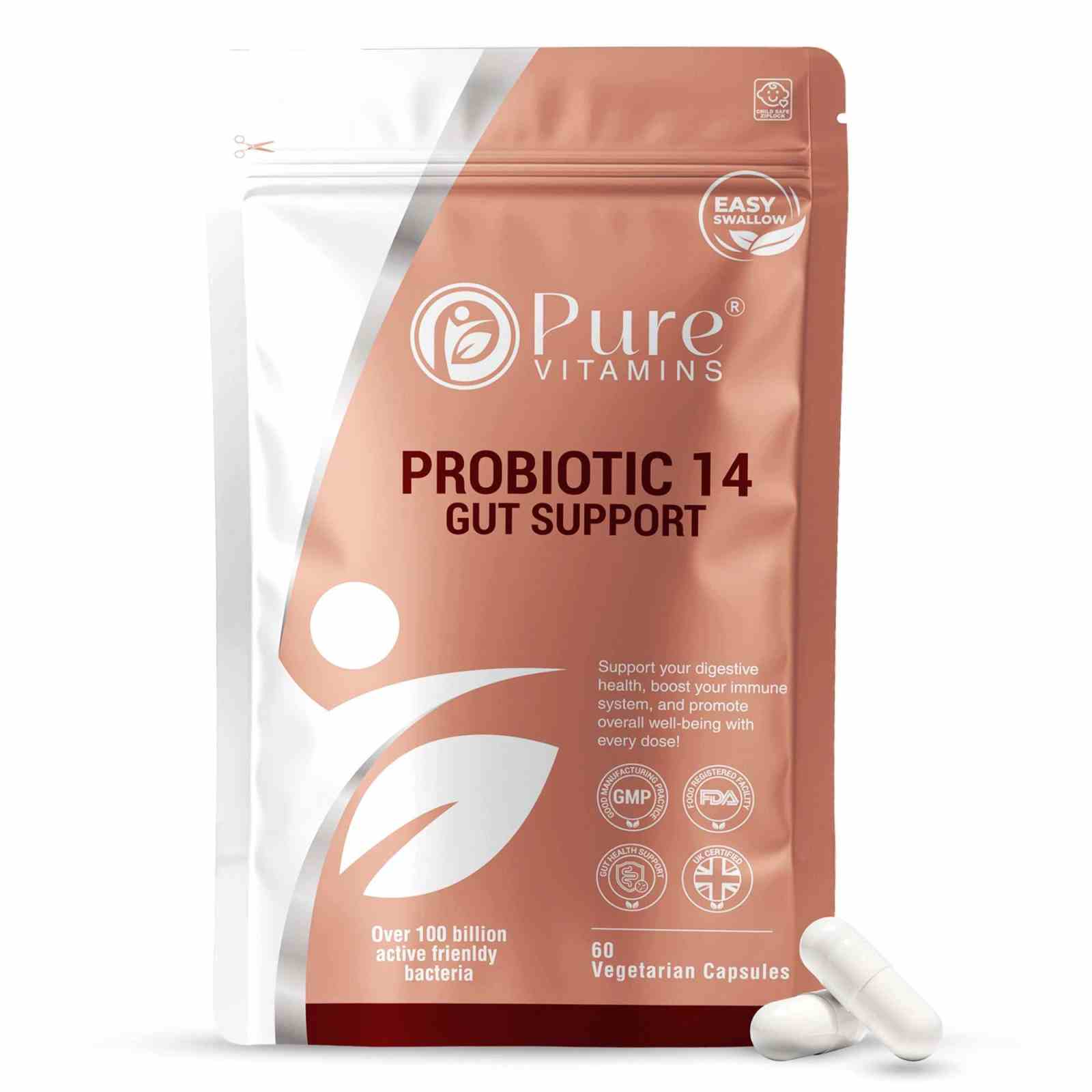
I built our Probiotic Capsules around exactly these principles: 14 strains, 100 billion CFU, prebiotic inulin, and a delayed-release acid-resistant capsule, one a day, shelf-stable, vegan, and made in a GMP-certified facility. It is described by what is genuinely in it. You can browse the wider range on our Pure Vitamins UK home page.
Frequently asked questions
Is there a probiotic specifically for women? Most strains are not female-specific, so the phrase is shorthand for a well-made, broad-spectrum probiotic. Judge it on strains, CFU, survival and prebiotics.
How many CFU do I need? There is no single right number. A sensible-to-high count with delayed-release delivery matters more than chasing the biggest figure.
Do probiotics need refrigerating? Some do and some are shelf-stable. Check the label; ours is shelf-stable.
Do multi-strain probiotics change the gut microbiome? Research in healthy adults has shown multi-strain probiotics can measurably shift gut microbial composition, which is one reason a diverse, named blend is a sensible starting point.
When should I take it? Daily and consistently. Around antibiotics, separate the two by a few hours.
Food supplements should not be used as a substitute for a varied, balanced diet and a healthy lifestyle. If you are pregnant, breastfeeding, taking medication or managing a medical condition, speak to your GP or pharmacist before starting a new supplement. Always consult a healthcare professional if you have ongoing digestive symptoms.
Dr. Miron, Founder of Pure Vitamins UK.
